Thursday, 22 March 2018

Bronchitis

Bronchitis is an inflammation of the lining of your bronchial tubes, which carry air to and from your lungs. People who have bronchitis often cough up thickened mucus, which can be discolored. Bronchitis may be either acute or chronic. 
Often developing from a cold or other respiratory infection, acute bronchitis is very common. Chronic bronchitis, a more serious condition, is a constant irritation or inflammation of the lining of the bronchial tubes, often due to smoking. 
Acute bronchitis usually improves within a few days without lasting effects, although you may continue to cough for weeks. However, if you have repeated bouts of bronchitis, you may have chronic bronchitis, which requires medical attention. Chronic bronchitis is one of the conditions included in chronic obstructive pulmonary disease (COPD). 

SYMPTOMS

For either acute bronchitis or chronic bronchitis, signs and symptoms may include:
  • Cough
  • Production of mucus (sputum), which can be clear, white, yellowish-gray or green in color — rarely, it may be streaked with blood
  • Fatigue
  • Shortness of breath
  • Slight fever and chills
  • Chest discomfort
If you have acute bronchitis, you may have a nagging cough that lingers for several weeks after the inflammation resolves. Chronic bronchitis is defined as a productive cough that lasts at least three months, with recurring bouts occurring for at least two consecutive years.
If you have chronic bronchitis, you're likely to have periods when your signs and symptoms worsen. At those times, you may have acute bronchitis on top of your chronic bronchitis.

CAUSES

Acute bronchitis is usually caused by viruses, typically the same viruses that cause colds and flu (influenza). Antibiotics don't kill viruses, so this type of medication isn't useful in most cases of bronchitis.
The most common cause of chronic bronchitis is smoking cigarettes. Air pollution and dust or toxic gases in the environment or workplace also can contribute to the condition.

RISK FACTORS

Factors that increase your risk of bronchitis include:
  • Cigarette smoke. People who smoke or who live with a smoker are at higher risk of both acute bronchitis and chronic bronchitis.
  • Low resistance. This may result from another acute illness, such as a cold, or from a chronic condition that compromises your immune system. Older adults, infants and young children have greater vulnerability to infection.
  • Exposure to irritants on the job. Your risk of developing bronchitis is greater if you work around certain lung irritants, such as grains or textiles, or are exposed to chemical fumes.
  • Gastric reflux. Repeated bouts of severe heartburn can irritate your throat and make you more prone to developing bronchitis.

COMPLICATIONS

Although a single episode of bronchitis usually isn't cause for concern, it can lead to pneumonia in some people. Repeated bouts of bronchitis may indicate that you're developing chronic obstructive pulmonary disease 

Breast cancer

Image result for breast cancer
Breast cancer is cancer that formes in the cells of the breasts.
After skin cancer, breast cancer is the most common cancer diagnosed in women in the United States.
Breast cancer can occur in both men and women, but it's far more common in women.
Substantial support for breast cancer awareness and research funding has helped improve the screening and diagnosis and advances in the treatment of breast cancer. Breast cancersurvival rates have increased, and the number of deaths steadily has been declining, which is largely due to a number of factors such as earlier detection, a new personalized approach to treatment and a better understanding of the disease.

SYMPTOMS

Signs and symptoms of breast cancer may include:
  • A breast lump or thickening that feels different from the surrounding tissue
  • Bloody discharge from the nipple
  • Change in the size, shape or appearance of a breast
  • Changes to the skin over the breast, such as dimpling
  • A newly inverted nipple
  • Peeling, scaling or flaking of the pigmented area of skin surrounding the nipple (areola) or breast skin
  • Redness or pitting of the skin over your breast, like the skin of an orange

CAUSES

It's not clear what causes breast cancer.
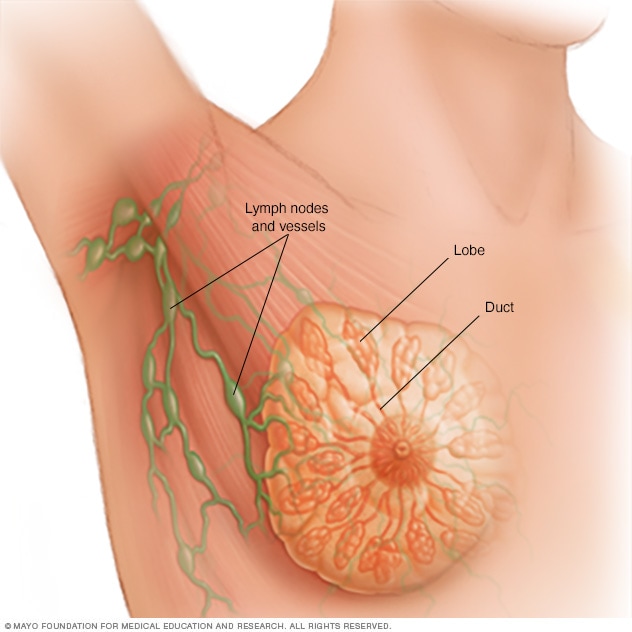
Doctors know that breast cancer occurs when some breast cells begin growing abnormally. These cells divide more rapidly than healthy cells do and continue to accumulate, forming a lump or mass. The cells may spread (metastasize) through your breast to your lymph nodes or to other parts of your body.
Breast cancer most often begins with cells in the milk-producing ducts (invasive ductal carcinoma). Breast cancer may also begin in the glandular tissue called lobules (invasive lobular carcinoma) or in other cells or tissue within the breast.
Researchers have identified hormonal, lifestyle and environmental factors that may increase your risk of breast cancer. But it's not clear why some people who have no risk factors develop cancer, yet other people with risk factors never do. It's likely that breast cancer is caused by a complex interaction of your genetic makeup and your environment.

Inherited breast cancer

Doctors estimate that only 5 to 10 percent of breast cancers are linked to gene mutations passed through generations of a family.
A number of inherited mutated genes that can increase the likelihood of breast cancer have been identified. The most common are breast cancer gene 1 (BRCA1) and breast cancer gene 2 (BRCA2), both of which significantly increase the risk of both breast and ovarian cancer.
If you have a strong family history of breast cancer or other cancers, your doctor may recommend a blood test to help identify specific mutations in BRCA or other genes that are being passed through your family.
Consider asking your doctor for a referral to a genetic counselor, who can review your family health history. A genetic counselor can also discuss the benefits, risks and limitations of genetic testing with you and guide you on appropriate genetic testing.

RISK FACTORS

A breast cancer risk factor is anything that makes it more likely you'll get breast cancer. But having one or even several breast cancerrisk factors doesn't necessarily mean you'll develop breast cancer. Many women who develop breast cancer have no known risk factors other than simply being women.
Factors that are associated with an increased risk of breast cancer include:


  • Being female. Women are much more likely than men are to develop breast cancer.
  • Increasing age. Your risk of breast cancer increases as you age.
  • A personal history of breast cancer. If you've had breast cancer in one breast, you have an increased risk of developing cancer in the other breast.
  • A family history of breast cancer. If your mother, sister or daughter was diagnosed with breast cancer, particularly at a young age, your risk of breast cancer is increased. Still, the majority of people diagnosed with breast cancer have no family history of the disease.
  • Inherited genes that increase cancerrisk. Certain gene mutations that increase the risk of breast cancer can be passed from parents to children. The most common gene mutations are referred to as BRCA1 and BRCA2. These genes can greatly increase your risk of breast cancer and other cancers, but they don't make cancer inevitable.
  • Radiation exposure. If you received radiation treatments to your chest as a child or young adult, your risk of breast cancer is increased.
  • Obesity. Being obese increases your risk of breast cancer.
  • Beginning your period at a younger age. Beginning your period before age 12 increases your risk of breast cancer.
  • Beginning menopause at an older age.If you began menopause at an older age, you're more likely to develop breast cancer.
  • Having your first child at an older age. Women who give birth to their first child after age 35 may have an increased risk of breast cancer.
  • Having never been pregnant. Women who have never been pregnant have a greater risk of breast cancer than do women who have had one or more pregnancies.
  • Postmenopausal hormone therapy.Women who take hormone therapy medications that combine estrogen and progesterone to treat the signs and symptoms of menopause have an increased risk of breast cancer. The risk of breast cancer decreases when women stop taking these medications.
  • Drinking alcohol. Drinking alcohol increases the risk of breast cancer.

CBSE BOARD CLASS -12 PHYSICS MOST IMPORTANT QUESTIONS.

Here is a link for class 12 physics most important physics questions - https://youtu.be/AwpPmtC8UJ8